
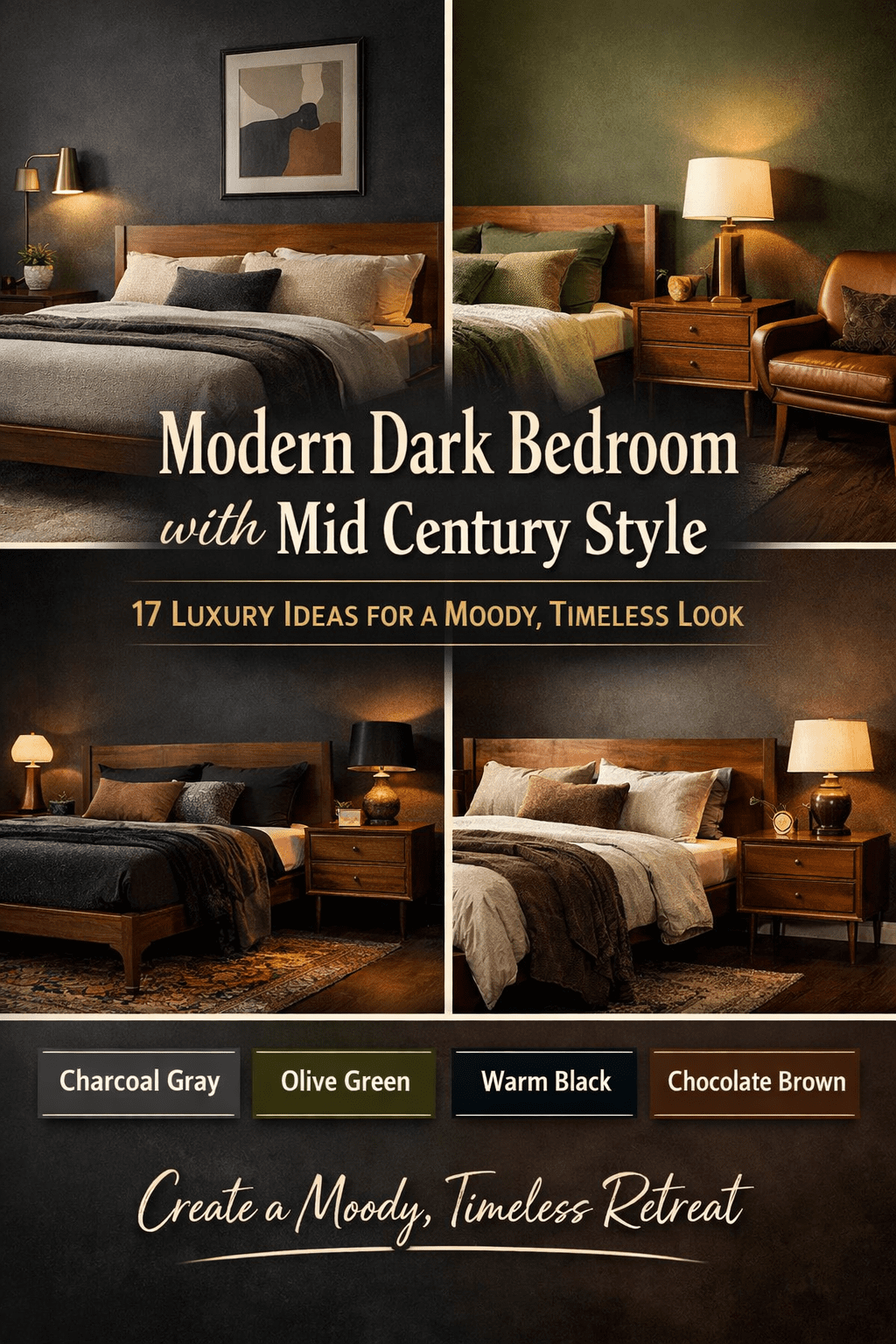
Modern dark bedroom ideas are becoming increasingly popular for their cozy and dramatic feel. When paired with mid-century style elements, they create a perfect balance of elegance and comfort.
Quick Navigation
Modern dark bedroom ideas are becoming increasingly popular for their cozy and dramatic feel. When paired with mid-century style elements, they create a perfect balance of elegance and comfort.
01 — Foundation
Start with the Right Dark Wall Color for Modern Dark Bedroom Ideas
The single most important decision in this style is paint. But not just any dark paint — you need shades with
warm undertones. Cool or blue-based darks will make the room feel icy and uninviting. Warm
darks — charcoal, olive, walnut-brown — feel like being wrapped in something.
Charcoal Gray
Deep Olive
Warm Black
Dark Taupe
Chocolate
Charcoal Gray — The Sophisticated Base

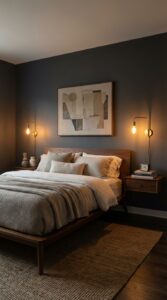
Charcoal gray walls with walnut furniture and brass accents — the classic combination.
Charcoal gray delivers depth without feeling overpowering. Unlike flat black, charcoal has subtle undertones that
soften the space and create a refined, balanced atmosphere. It works beautifully behind walnut platform beds,
tapered nightstands, sculptural brass sconces, and neutral textured bedding.
it, creating that coveted cocoon-like quality. Glossy finishes will cheapen the effect entirely for Modern dark bedroom ideas .
Deep Olive Green — Warm and Earthy Elegance
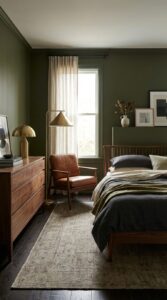
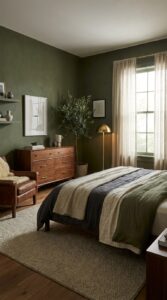
Deep olive green enhances natural wood tones and brings an organic, grounded warmth.
Deep olive green brings personality into a dark bedroom without feeling trendy. It works exceptionally well in
mid century interiors because it enhances the natural beauty of wood tones — walnut and teak practically glow
against it. It’s ideal if you want something darker than sage but softer than black. Pair with linen curtains
and layered neutral textiles to keep the look grounded and organic.
Warm Black — Bold Yet Cozy Drama
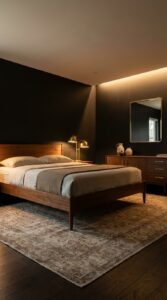
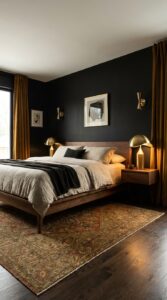
Warm black walls — not blue-based black — create a striking gallery effect with mid century
furniture.
When balanced correctly, warm black walls highlight wood grain beautifully, make brass fixtures glow, and create
dramatic contrast with white bedding. Mid century furniture with clean lines stands out sharply against a black
background. To soften the boldness, layer plush textiles, a vintage rug, and warm lighting sources throughout.
Dark Taupe & Chocolate Brown — Understated Luxury
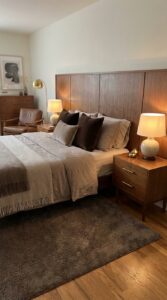
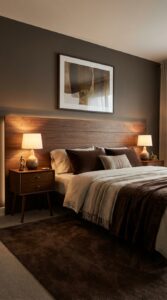
Dark taupe and chocolate brown create a boutique hotel atmosphere — calm, sophisticated,
deeply inviting.
For a dark bedroom that feels luxurious without being theatrical, dark taupe or chocolate brown are the answer.
These tones add richness while maintaining a welcoming atmosphere. Chocolate brown especially pairs beautifully
with leather accents and vintage-inspired decor, reinforcing the mid century character. Incorporate layered
lighting — bedside lamps, wall sconces, and soft overhead — to bring out the warmth in these tones.
02 — Furniture
Choose Walnut as Your Anchor Wood

Mid-century design is defined by warm wood, and walnut is its signature. In a dark room, the honey-brown richness
of walnut creates a premium contrast that grounds the entire space. Consider a walnut platform bed as your
centerpiece, then layer in tapered nightstands and a clean-lined dresser.
“In a dark room, walnut doesn’t just look good — it creates warmth. It’s the wood
that makes a charcoal bedroom feel like a retreat rather than a cave.”
One important rule: keep one wood tone dominant. Mixing walnut with cherry or pine creates visual noise that
undermines the whole effect. Commit to walnut and let it carry the room.
03 — Form
Keep Furniture Low and Structured

Mid-century silhouettes sit close to the ground. This isn’t just an aesthetic preference — low furniture makes a
dark room feel more spacious and intentional. Look for tapered legs, minimal hardware, and clean profiles. Avoid
anything bulky, ornate, or excessively upholstered.
The furniture should feel architectural against the dark walls — like pieces placed in a gallery. Each item earns
its space.
04 — Critical
Layer Warm Lighting Throughout

A dark bedroom lives or dies by its lighting. Use warm bulbs — around 2700K — and never rely on
a single overhead fixture. The goal is to layer multiple light sources so the room feels dimensional and
inviting after dark, not flat and shadowy.
architectural warmth · Ceiling pendant for ambient fill ·
LED accent strip behind the headboard for a soft glow
05 — Balance
Use Neutral Bedding for Balance
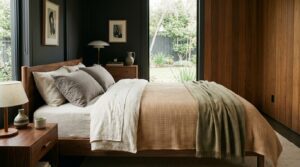
Dark walls need a counterpoint, and bedding is where you find it. Cream, warm beige, camel, soft gray, or muted
olive — these tones soften the contrast while keeping the room cohesive. Avoid cool whites or bright colors,
which will clash rather than complement.
Focus on texture over pattern. Linen, cotton, and waffle weaves are ideal. The bedding should
feel like a natural exhale against the drama of the walls — beautiful in its restraint.
06 — Texture
Add Velvet for Depth and Luxury
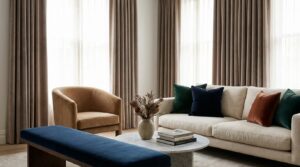
Velvet is the signature texture of quiet luxury. It catches and holds light in a way no other fabric does — in a
dark room, a velvet cushion or accent chair practically glows. A velvet cushion, upholstered bench, accent
chair, or set of drapes adds richness without cluttering the space. Choose deep jewel tones — forest green,
burnt amber, dusty mauve — to stay within the warm palette.
07 — Personality
Incorporate Mid-Century Lighting Fixtures
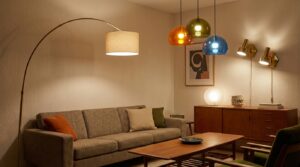
The fixture itself should feel like a piece of sculpture. Mid-century lighting is characterized by bold,
geometric shapes and warm metal finishes. Try globe lamps, brass wall sconces, dome pendants, or an arc floor
lamp for a classic 1960s-inspired silhouette. These pieces add personality and reinforce the era of the design
without feeling like a costume.
08 — Grounding
Add a Vintage-Inspired Rug

A vintage or Persian-style rug adds warmth and makes a dark bedroom feel finished. The key is choosing the right
tones — muted faded reds, warm browns, soft neutrals. You want the rug to complement the walnut furniture and
warm walls, not compete with them. Avoid anything too bright or geometrically modern; this is where vintage or
distressed patterns earn their place.
09 — Character
Use Abstract Art on the Walls
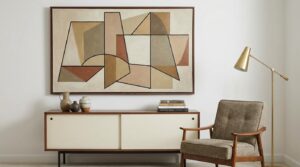
Abstract art is a natural match for mid-century interiors. It carries the same commitment to form over
decoration. Stick to a restrained palette and frame the work in black, walnut, or brass. Two or three pieces
grouped together creates a gallery-like effect that feels curated rather than accidental.
10 — Restraint
Keep Decor Minimal and Intentional
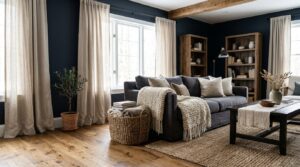
Dark rooms show clutter immediately. Every surface becomes a stage, which means every object on it matters.
Instead of filling nightstands and dressers with small knick-knacks, choose 3–5 intentional pieces
total: a tray, a candle, a simple vase, one sculptural object.
“In a dark room, empty surfaces don’t look bare — they look deliberate. That’s the
difference between clutter and luxury.”
Common Mistakes to Avoid
Even with the best intentions, these pitfalls can undermine the whole look:
- Choosing cool, blue-toned black paint. It reads as cold and clinical — the opposite of
what you want. Always check for warm undertones before committing. - Using cold white bulbs (5000K+). They destroy the warmth of the entire room. Anything
above 3000K in a dark bedroom is a mistake. Stick to 2700K. - Mixing too many wood tones. Pick walnut and stay with it. Every deviation creates
visual noise that chips away at the cohesion of the space. - Overcrowding surfaces with small objects. They disappear in dark rooms and create
clutter. Use fewer, larger pieces with genuine intention. - Skipping texture entirely. Without layered materials, dark rooms become flat and
heavy. Texture is what keeps the space dimensional and alive.
Frequently Asked Questions
What’s the best paint color for a modern dark bedroom Ideas?
Warm charcoal, deep olive green, warm black, and dark taupe are all excellent choices. The
defining factor is undertone — always choose a shade with warm, not cool, undertones. Pair any of these with
a matte or eggshell finish for the best result.
What wood tone works best with dark walls?
Walnut is the definitive answer. Its warm honey-brown tones create a rich, premium contrast
against dark walls — especially charcoal and black. Teak is a close second. Keep one wood dominant
throughout the room to avoid visual fragmentation.
How do I make a dark bedroom feel cozy rather than gloomy?
Three things: warm lighting (2700K bulbs, multiple layered sources), rich textures (linen,
velvet, wool throws, a vintage rug), and a light ceiling. Together, these elements transform a potentially
oppressive dark room into a genuinely inviting retreat.
Can I use black walls in a mid-century style bedroom?
Yes — but the type of black matters enormously. Choose a warm black with brown or red
undertones, not a blue-based black. Pair it with walnut furniture, brass lighting, and plush textiles.
Always use a matte finish — glossy black reduces the room and reflects harshly.
What bedding colors work best with dark bedroom walls?
Cream, warm beige, camel, soft gray, and muted olive. Avoid cool whites or anything too
bright. The bedding should feel like a natural contrast — softening the dark walls while remaining within
the same warm palette. Texture (linen, cotton, waffle weave) matters more than color here.
